
Over the past three decades, I’ve had the privilege of building businesses, advising entrepreneurs, leading agencies, mentoring professionals, and speaking with thousands of marketers about career growth. One theme keeps resurfacing regardless of age, title, or income level. Most people are successful despite how they spend their time, not because of it. I was reminded of this recently during a conversation with a veteran public relations agency owner. We spent several hours discussing the challenges agency leaders face as they mature professionally.
Many founders eventually reach a point where they no longer want to grind through the same responsibilities that helped them build their business in the first place. Others discover they have outgrown their role entirely.
The discussion inspired two simple exercises that can help clarify both your current work and your future direction. The first exercise focuses on the next thirty days, while the second exercise focuses on the next ten years. Together, they can become a powerful guide for building a more rewarding and profitable career.
Exercise One: Audit Your Work, Not Your Job Title
Any professional tells you their title, but far fewer can tell you how they spend their day. Agency owners are especially guilty of this. We often describe ourselves as CEOs, consultants, strategists, account directors, salespeople, or business developers. Our calendars are filled with dozens of unrelated activities that compete for our time and attention.
For the next two to four weeks, document every meaningful task you perform throughout the day. Do not overthink it. Keep a running list in a spreadsheet, notebook, or note-taking app. Record meetings, presentations, writing, sales calls, recruiting, bookkeeping, networking, client strategy sessions, proposal development, administrative work, project management, social media activity, and everything in between. Once you have accumulated enough data, place each task into one of four categories outlined in the image below:
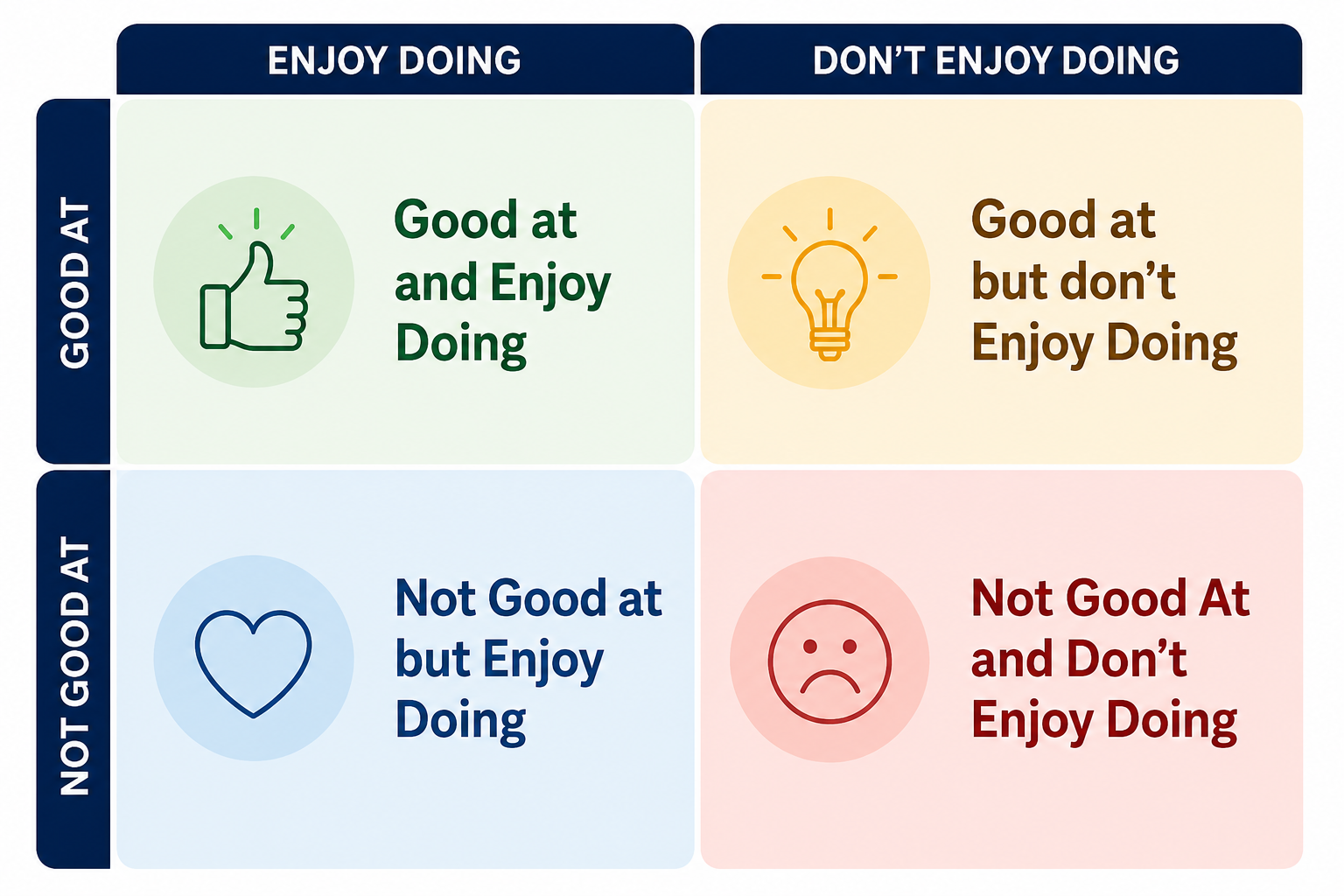
Once you’ve categorized all activities, you may be surprised by the results. The top left quadrant often reveals the activities that generate the most energy, satisfaction, and impact. These are the tasks where time seems to disappear. You finish them feeling accomplished rather than exhausted. This is your sweet spot.
The upper right quadrant is equally interesting. These are activities you enjoy but have not yet mastered. They often represent growth opportunities. Investing time in training, coaching, or practice may transform these into future strengths.
The lower left quadrant can be deceptive. These are tasks you’re capable of performing well but no longer enjoy. Many experienced professionals spend years trapped here because competence creates demand. Clients, colleagues, and employees continue asking for help because you’re good at it. The problem is that excellence without enjoyment eventually leads to burnout.
The bottom right quadrant is where trouble lives. These are activities you neither enjoy nor perform particularly well. Every hour spent here drains energy and creates frustration.
Whenever possible, these tasks should be delegated, automated, outsourced, or eliminated. The same is true of the bottom left quadrant.
One agency owner I worked with discovered that nearly twenty percent of her week was spent on bookkeeping, software administration, and operational troubleshooting. She disliked every minute of it. After hiring part-time support and implementing better systems, she redirected that time toward business development and strategic consulting.
Within weeks, her stress decreased while productivity and revenue increased. Nothing changed except how she spent her time. The lesson is simple: you don’t need a new job to become happier. Sometimes you simply need a better understanding of your current one.
Exercise Two: Designing Your Next Chapter
The second exercise addresses a longer-term question: What comes next? Many professionals eventually reach a stage where success alone is no longer enough. They begin searching for greater meaning, flexibility, impact, or income. The challenge is that most people approach this question from only one angle.
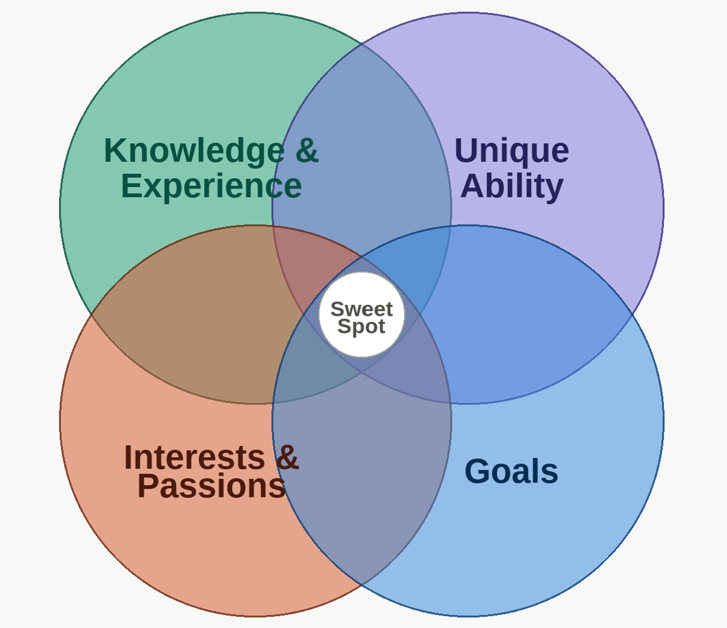
Some professionals at a crossroads focus exclusively on money, while others focus entirely on passion. Neither approach is sufficient. I’ve found that the most fulfilling opportunities typically exist at the intersection of four factors:
- Knowledge and Experience
- Unique Ability
- Interests and Passions
- Goals
Think of these as four overlapping circles: where they intersect lies your professional sweet spot (and success, however you choose to define it):
Let’s look at each component individually.
Knowledge and Experience
This includes everything you’ve learned throughout your career, including industries served, skills developed, relationships built, mistakes survived, and credentials earned. Many professionals underestimate the value of accumulated experience because it feels ordinary to them. What comes naturally after twenty years may be highly valuable to someone with two years of experience (even with the looming specter of AI).
Unique Ability
This concept comes from Dan Sullivan’s Strategic Coach framework and has influenced my thinking for years. Your unique ability is not simply what you’re good at; it’s what you do exceptionally well while creating value for others and gaining energy from the process. For some people, it’s strategic thinking, while for others, it may be world-class storytelling, relationship building, leadership, coaching, problem solving, or sales. The clue often lies in the compliments you receive repeatedly throughout your career. Pay attention to what others consistently reach out to you for to seek your help.
Interests and Passions
Passion alone may not create a business. However, ignoring your interests can even make a successful career feel empty. When evaluating future opportunities, ask yourself:
- What topics do I read about without being asked?
- What conversations energize me?
- What projects would I pursue even if no one paid me initially?
The answers often reveal hidden opportunities. Combining your interests and passions with your revenue-generation activities can make “work” not seem like work at all. For example, I’m enthusiastic about cars and when I had the opportunity to work with a company that hosted driving experiences involving exotic car tours on backgrounds, I felt like I’d entered Nirvana.
Goals
Goals provide direction for us all. My experience setting short, mid-term and long-term goals transformed my life, not just my earning potential. Within five years of crafting personal and professional goals, I’d tripled my salary, purchased my dream car, and found my soul mate.
You may not share my goals, but you can share a similar path towards achieving your own goals. Whether your focus is on increasing income, skills, responsibility, freedom or creating a legacy, clarity and focus are essential. Without clearly defined goals, it becomes difficult to evaluate opportunities objectively. I recommend setting 1-, 2-, 5-and 10-year goals, both personally and professionally, and posting them somewhere you (and others) see it daily. Hold yourself accountable and you will achieve your goals.
Finding the Bullseye
In a more recent meeting, I reconnected with an agency owner whom I respect immensely. Unlike my first example, she is in a much better place in terms of harnessing her knowledge, passion, and unique ability to generate a sizable retirement. What she was missing, however, was goals for the next five to ten years. I recommend she tackle both exercises to create focus and enthusiasm for her remaining years running her agency.
My long-time associate was unusual in her ability to check three of the four quadrants off, but she hadn’t yet found her sweet spot. The real magic happens when all four circles overlap. For me, that intersection has evolved over time. Early in my career, digital marketing consulting was the bullseye in terms of knowledge and financial goals. Later, speaking, writing, mentoring, and community building became increasingly important as they leveraged my unique ability.
However, I always struggled to incorporate my passions and interests, until now. I’ve recently realized my knowledge and financial goals can be achieved as a fractional CMO, but my passion and unique ability are best leveraged as a business coach and advisor to entrepreneurs and business owners. Whether that ultimately becomes my next chapter remains to be seen, but the exercise provides clarity, and clarity creates confidence.
Your Assignment
Set aside thirty minutes this week and start tracking your activities. In real time (or after completing the two-to-four-week audit), categorize each task into the four quadrants: which activities are enjoyable and at which you are competent and which you are not. Once you’ve completed the quadrants, plan to automate, delegate or eliminate any activities below the “horizon” for which you don’t enjoy or are not competent.
The second phase is to spend time identifying the overlap between your experience, abilities, passions, and goals. You may discover that your dream role is already sitting inside your current position. You may uncover an entirely new direction, but either outcome is a win. Life is too short to spend most of your waking hours doing work you’re not good at and don’t enjoy. The goal isn’t simply to make a living, it’s to build a career and a life that leverages your strengths, creates value for others, and leaves you excited to start each day.
Related articles:
Take this quiz to find out if you’ve found your Dream Job
Six steps to a fulfilling and financially rewarding career
Your Next Career Chapter: Monetizing Strengths, Knowledge, and Networks