
With The Great Resignation, Great Gloom, and Quiet Quitting plaguing employers, organizations are increasingly recognizing the importance of employee experience (EX). A positive EX can lead to a range of benefits, including increased engagement and productivity, reduced turnover, and improved customer satisfaction. Auditing the employee journey is a crucial step in identifying areas for improvement and enhancing overall EX. Auditing the employee journey is a critical aspect of organizational success, as it allows companies to identify strengths, weaknesses, and areas for improvement in the overall employee experience. In this article, we will outline essential steps when auditing the employee journey in any company.
Defining an Employee Journey Audit
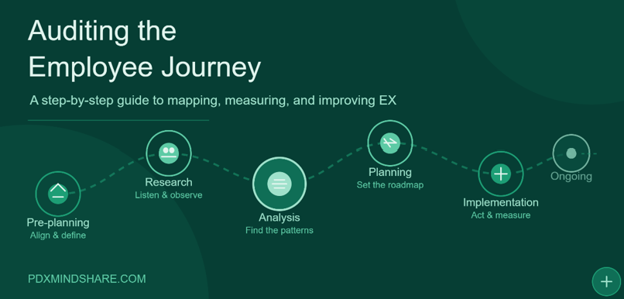
For context, an employee journey audit is a systematic process of evaluating the various touchpoints that employees experience throughout their employment, from recruitment to offboarding. It involves gathering feedback from employees at all levels and analyzing data to identify patterns and trends. The goal of an employee journey audit is to identify areas where the employee experience can be improved. There are five key steps involved with an employee journey audit: pre-planning, research, analysis, planning, implementation, and management.
Investment and Return
Despite compelling data regarding the return-on-investment (ROI) for investments in employee experience (80 percent in 10 years, according to research), leadership may be hesitant to make the initial investment in an audit. The cost of an Employee Journey Audit can be high and should be budgeted for well in advance and over as long a three-year period. While pre-planning may start at $5,000-10,000, a complete audit and plan can run into six figures, depending on company size, audit scope, duration, and resources required to complete the process.
Pre-Planning Phase
While it is natural for HR professionals to dive right into employee interviews or even mapping out a strategic plan, it is important to take a step back and conduct pre-planning with leadership to ensure alignment, support, and to maximize the value of the output. The first two steps in the pre-planning phase include defining the journey and mapping out the major milestones of the employees’ journey as a starting point. Before diving into the audit process, it’s essential to clearly define the employee journey. This journey typically includes stages such as awareness, recruitment, onboarding, training, daily work experience, performance management, professional development, engagement initiatives, and offboarding. The next step is to visually map out the major touchpoints and steps in the current employee journey at your company. Based on the initial audit scope defined in step one, start filling in the map with detailed steps. Most importantly, actively involve employees in all stages of the audit process, from data collection to recommendation development. This will ensure that the audit is grounded in real-world employee experiences.
Research Phase
The meat of the audit is conducted during the research phase. The audit is comprehensive in nature and should incorporate a mix of strategies, including longitudinal action research (assessing the impact of company policies and procedures on employee behavior and retention over time), ethnographic (field-style observational assessments), qualitative (employee interviews and focus groups), quantitative (large scale surveys that may include employees, partners, vendors and customers) and secondary research (competitor benchmarking, industry research, etc.). In addition, there are a host of elements and evaluation criteria to consider during the research phase.
- Conduct surveys and interviews with employees at various stages of the journey.
- Evaluate the effectiveness of communication channels within the organization.
- Examine existing company policies and procedures to ensure they align with industry standards, legal requirements, and employee expectations.
- Assess the organization’s training and development initiatives.
- Evaluate the effectiveness of the performance management system.
Analysis Phase
An obvious, yet critical, step in the employee journey audit is to analyze the reams of data compiled during the research phase. Synthesizing and analyzing the data to create actionable insights is the overall objective of this stage. Analyze the data collected to identify patterns, trends, and areas for improvement. Look for common themes, such as dissatisfaction with specific processes, communication gaps, or feelings of disengagement.
Strategic Plan Phase
Based on insights gained from the analysis phase, it’s now time to build a strategic plan to create an optimal employee journey. Without accountability and a reasonable but meaningful timeline to complete the recommended tasks, the plan will only be a fever dream. Based on your research, prioritize three to five key areas you will focus improvement efforts on first. These should be high-impact areas that will make a notable difference in the journey if enhanced.
Implementation and Management Phase
Employee journey auditing is not a one-time event. It should be an ongoing process to ensure that EX remains a top priority. As such, the plan’s implementation should be measured over years, not months. This requires accurate reporting, timely communication, and ongoing evaluation and oversight. For an employee journey plan to be successful in improving the overall experience and efficacy, the ongoing management should include clear communication, as well as real-time reporting that is accurate and actionable.
By following these steps and considering the key considerations, any organization can effectively audit the employee journey, identify areas for improvement, and implement strategies to enhance EX. A positive EX can lead to a more engaged, productive, and loyal workforce, ultimately positively impacting customer experience and contributing to the overall success of the organization.